
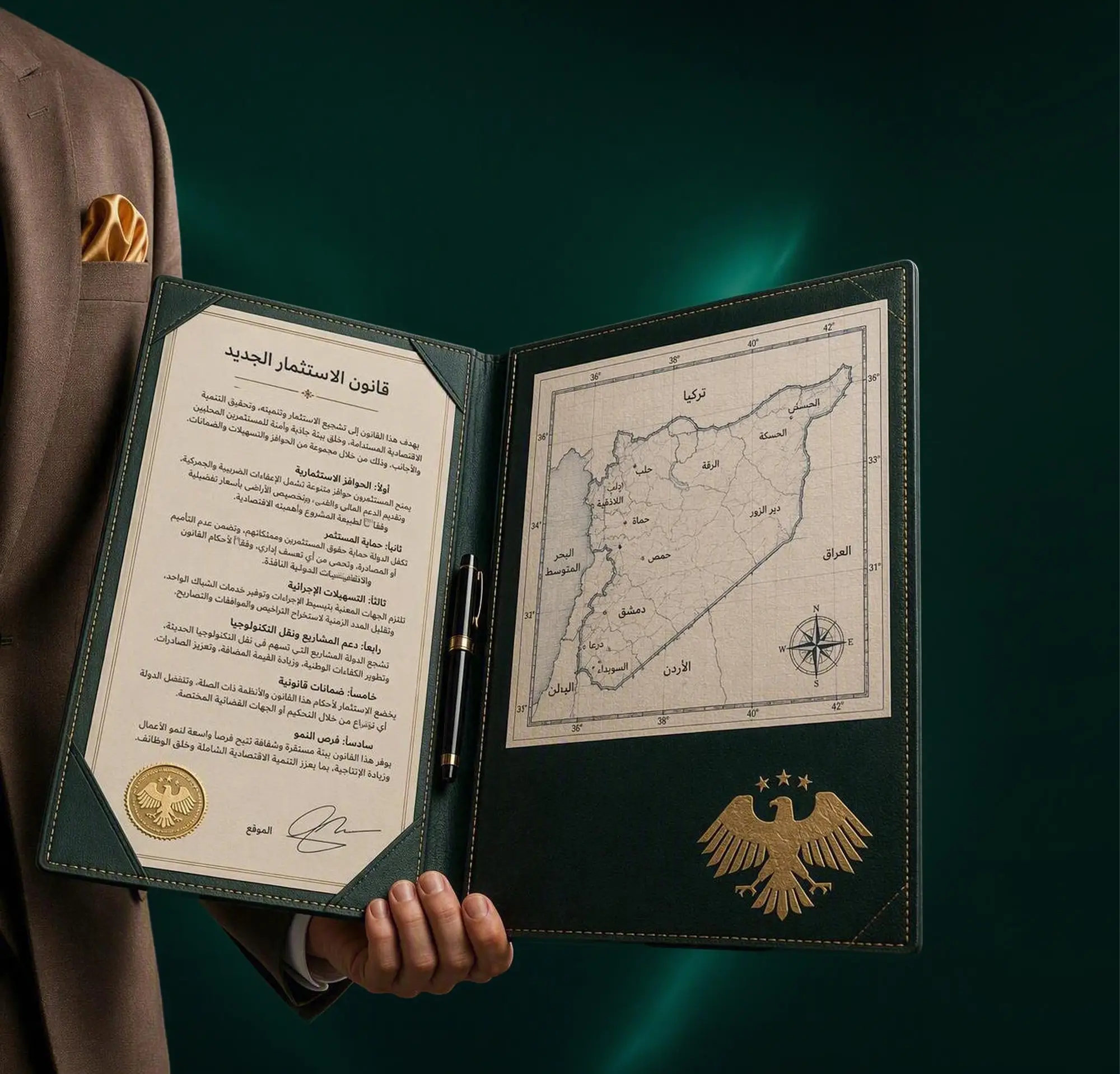
Syria’s investment sector is entering a new phase of restructuring and development, driven by the need to revitalize productive sectors, attract Syrian, Arab, and foreign capital, facilitate project establishment, and provide a clearer environment for investors seeking to enter the Syrian market or expand their existing investments.
In this context, Legislative Decree No. 114 of 2025 was issued on June 24, 2025, introducing significant amendments to several provisions of Investment Law No. 18 of 2021, as amended.
The amendments covered the definition and scope of investment, eligible investor categories, the role of the Syrian Investment Authority, investment licenses, the Investor Services Center, investment incentives and guarantees, special economic zones, and investment dispute settlement mechanisms.
The significance of these amendments extends beyond their legal implications. They may have a direct practical impact on feasibility studies and investment decision-making, particularly through incentives, exemptions, and tax reductions that may reach substantial levels in certain cases, alongside the possibility of full foreign ownership and the employment of foreign workers within specified limits.
In this guide, Jadwa Al Yaqeen Investment provides a comprehensive and practical analysis of Syria’s investment framework, bringing together legal provisions, figures, incentives, guarantees, and risks to help investors understand potential opportunities before committing capital.
Syrian Investment Law at a Glance
The key figures and percentages commonly associated with the investment framework and its applications can be summarized as follows:
- Up to 100% foreign ownership of an eligible investment project, without requiring a local partner in cases permitted under the applicable legal framework.
- Up to 40% foreign workforce of the project’s total employees when specialized technical, administrative, or operational expertise is not locally available, subject to the required approvals and applicable regulations.
- Up to 100% tax exemption for certain projects in the agricultural, livestock, and healthcare sectors, depending on project classification and compliance with eligibility requirements.
- Tax reductions of up to 80% for certain priority industrial, export-oriented, and development projects.
- Up to 100% customs exemption for machinery, production lines, equipment, construction machinery, and hospital equipment when required for the project and included in its investment license.
- The possibility of introducing foreign funds and capital and transferring profits in accordance with applicable financial, banking, and foreign exchange regulations.
- Implementation of the one-stop-shop system through the Investor Services Center to streamline licensing and approval procedures.
- Investors may enter the market through project establishment, expansion, development, financing, full or partial ownership, or management.
In August 2026, the Syrian Investment Authority presented full customs exemptions for machinery, production lines, construction equipment, and hospital equipment. It also presented full tax exemptions for agricultural, livestock, and healthcare projects, in addition to tax reductions of up to 80% for selected industrial and development sectors.
Official sources also referred to full foreign ownership of up to 100% and the possibility of employing foreign workers at a rate of up to 40%.
These percentages do not mean that every project automatically qualifies for the stated incentives. Eligibility depends on the project’s sector, location, economic impact, employment contribution, classification, and compliance with the conditions of the investment license and applicable executive instructions.
Important Legal Notice
The term “New Syrian Investment Law of 2025” is widely used in media and commercial content. However, the more legally accurate description is:
Legislative Decree No. 114 of 2025, amending certain provisions of Investment Law No. 18 of 2021.
Legislative Decree No. 114 does not repeal Investment Law No. 18 of 2021 or replace it with an entirely independent law. Instead, it amends certain provisions of the existing law.
Accordingly, Syria’s investment framework should be understood as an integrated system comprising:
- Investment Law No. 18 of 2021.
- Law No. 2 of 2023, which amended certain provisions of the Investment Law.
- Legislative Decree No. 114 of 2025.
- The executive instructions issued in 2025.
- Procedural guides and sector-specific regulations.
- Relevant tax, customs, banking, labor, and foreign exchange legislation.
Updated executive instructions were issued in November 2025. These instructions addressed sector classification, incentives and advantages, procedures for granting and revoking investment licenses, investor rights and obligations, special economic zones, real estate development and investment zones, and investment dispute settlement mechanisms.
What Changed in the Definition of Investment?
Legislative Decree No. 114 significantly expanded the definition of investment.
Investment is no longer limited to establishing a new economic entity. It now includes the employment of capital for the purpose of:
- Establishing an investment project.
- Expanding an existing project.
- Developing or modernizing a project.
- Financing a project.
- Acquiring full ownership of a project.
- Acquiring a partial ownership interest in a project.
- Managing an investment project.
This expanded definition represents an important shift because it enables investors to enter the Syrian market through several investment structures rather than limiting investment to establishing a new project from the ground up.
An investor may therefore enter the Syrian market by acquiring an existing project, purchasing a stake in a company, financing its expansion, participating in its management, or introducing technology and technical expertise, subject to applicable laws and regulations.
Who Qualifies as an Investor?
The legal definition of an investor includes any natural or legal person, whether Syrian or non-Syrian, who invests within the territory of the Syrian Arab Republic in accordance with the Investment Law and its amendments.
This definition may include:
- Syrian investors residing inside Syria.
- Syrian investors residing abroad.
- Syrian private companies.
- Arab and foreign companies.
- Investment funds.
- Holding companies.
- Companies seeking to form local partnerships.
- Investors seeking to acquire interests in existing projects.
- Licensed real estate developers and investors.
- Entities that finance projects or participate in their management.
The definition confirms that investment is not restricted to a particular nationality. However, it does not eliminate sector-specific restrictions or licensing requirements applicable to certain activities.
Up to 100% Foreign Ownership
One of the most attractive aspects of the investment framework is the possibility for a foreign investor to own up to 100% of an investment project in cases and sectors permitted under applicable laws and regulations, without a general requirement to appoint a local partner.
Full foreign ownership provides investors with greater ability to:
- Control project management.
- Make operational and strategic decisions.
- Protect proprietary technology and technical knowledge.
- Organize the project’s financial structure.
- Select the executive management team.
- Establish expansion and exit strategies.
- Retain the project’s returns after settling applicable obligations.
The possibility of up to 100% foreign ownership has been presented as an important measure for enhancing the attractiveness of Syria’s investment environment and reducing restrictions associated with mandatory local partnerships.
However, full ownership of a company does not necessarily mean unrestricted ownership of real estate or permission to carry out every economic activity without additional approvals.
Certain sectors, land categories, and properties may remain subject to special legislation. Investors should therefore distinguish between ownership of the legal entity, ownership of the project, ownership of real estate, and licensing of the relevant activity.
Foreign Workforce of Up to 40%
According to the announced investment advantages, an investment project may employ foreign workers at a rate of up to 40% when specialized technical, administrative, or operational expertise is required.
Such employment remains subject to the required approvals and compliance with labor, residency, and work permit regulations.
This flexibility may be particularly beneficial for projects requiring:
- Specialized engineers.
- Production-line installation experts.
- Executive managers.
- International quality and standards specialists.
- Technicians capable of operating advanced technologies.
- Consultants during the establishment and operational stages.
- Expertise that is insufficiently available in the local labor market.
From a feasibility perspective, the cost of foreign employees should include salaries, accommodation, insurance, transportation, residency costs, taxes, and other related expenses.
These costs should be compared with the cost of training local employees and transferring technical knowledge to them.
Investors are also advised to establish a gradual localization plan aimed at training Syrian employees and reducing dependence on foreign expertise once operations have stabilized.
Full Tax Exemptions for Selected Sectors
The announced incentives include full tax exemptions for certain projects operating in priority economic and development sectors, particularly:
- Agriculture.
- Livestock production.
- Healthcare.
According to information presented by the Syrian Investment Authority in August 2026, eligible projects in these sectors may receive full tax exemptions, subject to project classification, licensing, and compliance with applicable conditions and requirements.
Eligible agricultural and livestock projects may include, depending on their classification and applicable regulations:
- Agricultural production.
- Greenhouse farming.
- Modern irrigation projects.
- Cattle, sheep, and poultry farming.
- Milk, meat, and egg production.
- Sorting, packaging, and refrigerated storage centers.
- Agricultural services directly connected to production.
- Animal feed and integrated livestock production projects.
Eligible healthcare projects may include:
- Hospitals.
- Specialized medical centers.
- Certain healthcare facilities.
- Projects related to medical equipment.
- Healthcare services with a developmental impact.
A full tax exemption should not be incorporated into a project’s financial model before obtaining written confirmation of the project’s eligibility, the duration of the exemption, the applicable tax categories, and the implementation mechanism.
Tax Reductions of Up to 80%
Certain industrial, export-oriented, and development projects may qualify for tax reductions of up to 80%, particularly projects that generate high added value, support exports, contribute to local development, or create employment opportunities.
The applicable reduction may be influenced by several criteria, including:
- The nature of the sector.
- The type of product.
- The percentage of production allocated for export.
- The project’s location.
- The number of jobs created.
- The total investment value.
- The percentage of local inputs.
- The level of technology used.
- The project’s developmental impact.
- Its contribution to import substitution.
- Its contribution to generating foreign currency.
From a financial perspective, an 80% tax reduction does not necessarily exempt a project from all taxes and fees. It means that the specific tax liability covered by the relevant decision or investment license may be reduced by 80%, subject to its terms and conditions.
For illustrative purposes only, if a project’s calculated tax liability is 100 monetary units, an 80% reduction would reduce that liability to 20 monetary units, unless other taxes, duties, or obligations remain applicable.
Up to 100% Customs Exemption
The announced incentives include full customs exemption for several types of assets and equipment required by eligible projects, including:
- Industrial machinery.
- Production lines.
- Equipment.
- Technical installations.
- Tools directly related to production.
- Construction machinery allocated to the project.
- Machinery and equipment required by hospitals.
- Non-passenger vehicles connected to project operations, when included in the relevant approval.
The Syrian Investment Authority has presented full customs exemption for machinery, production lines, construction equipment, and hospital equipment as part of the advantages available to eligible investment projects.
A customs exemption does not necessarily exempt the project from all import-related expenses. Other costs may remain payable, including:
- International shipping.
- Insurance.
- Unloading and handling.
- Customs clearance services.
- Storage.
- Technical inspection.
- Port or border-crossing service charges.
- Domestic transportation.
- Equipment installation and commissioning.
- Service fees or charges not covered by the exemption.
A feasibility study should therefore distinguish between exempt customs duties and the total landed cost of delivering the equipment to the project site.
Numerical Example of the Customs Exemption’s Impact
Assume that the value of a production line is USD 1 million and that the hypothetical customs duty before exemption is 10%.
A full customs exemption could theoretically save USD 100,000 in customs duties.
However, this does not mean that the final cost of the equipment will be limited to USD 1 million. The project may still incur shipping, insurance, clearance, transportation, installation, training, spare parts, and commissioning costs.
This example is provided for illustrative purposes only and does not represent a fixed customs tariff. The original customs rate and calculation method vary depending on the equipment type, customs classification code, country of origin, and applicable regulations.
Investment License and Application Process
Legislative Decree No. 114 defines an investment license as a document granted by the Syrian Investment Authority after reviewing the investor’s application and obtaining the approvals and licenses required for the project to begin implementation.
This means that an investment license is connected to an integrated process and is not merely a preliminary approval separate from the required licenses.
Depending on the nature of the project, the application file may include:
- Investor and shareholder information.
- Project description.
- Economic feasibility study.
- Technical study.
- Financing plan.
- Sources of capital.
- Legal structure.
- Project location.
- Real estate documents.
- Machinery and production-line details.
- Operational plan.
- Number of employees.
- Proposed percentage of foreign employees, when required.
- Expected export volume.
- Project establishment timetable.
- Financial projections.
- Environmental and sector-specific approvals.
There is no single processing period that applies to all projects. The required time may be affected by document completeness, the nature of the activity, the number of relevant authorities, and the sector-specific approvals required.
Investor Services Center and the One-Stop Shop
The Investor Services Center serves as a direct point of contact between investors and the public authorities involved in their projects.
The relevant investment authorities are represented through a one-stop-shop structure intended to:
- Reduce the number of authorities an investor must visit.
- Unify application submission channels.
- Follow up on licenses and approvals.
- Clarify required documents and fees.
- Reduce processing time.
- Provide a clear reference point for application follow-up.
- Address delays or missing documents.
- Facilitate the transition from licensing to implementation.
The definition of the Procedural Guide refers to a binding timeframe for procedures while setting out the conditions, technical standards, and financial obligations associated with project establishment and licensing.
What Is an Investment Project?
An investment project is an economic activity established by an investor in accordance with the applicable investment framework.
It may involve establishing a new project, expanding or developing an existing project, financing a project, acquiring full or partial ownership, or managing an existing project.
Investment projects may operate in sectors such as:
- Industry.
- Agriculture.
- Livestock production.
- Healthcare.
- Tourism.
- Energy and electricity.
- Oil and mineral resources.
- Telecommunications and technology.
- Environmental services.
- General services.
- Housing and real estate development.
The executive instructions classify a broad range of investment sectors, while each sector remains subject to the laws and regulations governing its specific activities.
Priority Investment Sectors
Certain sectors may receive greater priority because of their contribution to production, employment, exports, and development.
Industry and Manufacturing
This category includes manufacturing, food processing, pharmaceuticals, engineering industries, textiles, construction materials, packaging, and related activities.
An industrial project may become more attractive when it contributes to import substitution, uses local raw materials, or allocates part of its production for export.
Agriculture and Livestock Production
This sector is particularly important because of its connection to food security, rural employment, and the supply of raw materials for food-processing industries.
Eligible projects in this sector may receive full tax exemptions, subject to applicable classification and regulatory conditions.
Healthcare and Medical Industries
This category includes hospitals, medical centers, pharmaceutical manufacturing, medical supplies, and medical equipment.
Eligible healthcare projects may receive full tax exemptions alongside customs exemptions for hospital equipment.
Energy and Renewable Energy
Solar, wind, electricity generation, and energy-efficiency projects are increasingly important because reliable energy directly affects the continuity and productivity of other economic sectors.
Real Estate Development and Investment
This category includes urban, residential, and commercial development projects, as well as real estate development and investment zones.
Before investing, it is essential to verify the property register, zoning status, ownership rights, restrictions, encumbrances, and other conditions affecting the land.
Transportation and Logistics
This category includes warehouses, distribution centers, transportation, freight, refrigerated storage, and services linked to border crossings, ports, and markets.
Technology and Telecommunications
This category includes software, digital services, data centers, technical solutions, and outsourcing services, subject to sector-specific licensing and data protection requirements.
Special Economic Zones
Legislative Decree No. 114 defines a special economic zone as an investment area established for a specific economic activity and governed by regulations corresponding to its nature and location.
Special economic zones may be suitable for projects that are:
- Industrial.
- Export-oriented.
- Logistics-based.
- Technology-focused.
- Connected to border crossings or ports.
- Labor-intensive.
- Based on integrated supply chains.
The decision to invest in a special economic zone should not be based on incentives alone.
A comprehensive comparison should consider the cost of land, energy, transportation, labor, infrastructure, proximity to target markets, and conditions governing the movement of goods into and out of the zone.
Fixed Assets Included in the Project
Fixed assets include the assets used to establish and operate the project, such as:
- Buildings.
- Machinery.
- Tools.
- Installations.
- Equipment.
- Production lines.
- Non-passenger vehicles connected to project operations.
These assets should be recorded in a clear asset register. Investors should also retain invoices, technical specifications, import documentation, certificates of origin, and exemption documents.
Project Financing and Foreign Capital
Foreign capital includes funds duly introduced into Syria from abroad by Syrian or non-Syrian natural or legal persons, including certain intellectual and intangible rights subject to applicable legal requirements.
To protect the investor’s rights, the investor should:
- Transfer financing through approved channels.
- Document the source of funds.
- Retain transfer records.
- Register capital contributions.
- Document shareholder loans.
- Register in-kind contributions.
- Separate the investor’s personal accounts from the company’s accounts.
- Maintain compliant accounting records.
- Document profits and distributions.
These measures may subsequently facilitate the transfer of profits, the sale of shares, capital repatriation, or an exit from the investment.
Transfer of Profits and Capital
The transfer of profits and capital is one of the most important considerations for foreign investors and Syrian investors residing abroad.
The investment framework permits the transfer of profits and funds in accordance with applicable financial, banking, and foreign exchange regulations, provided that capital entry is properly documented, taxes and obligations are settled, and distributable profits are established.
Investors should ensure:
- That funds enter through official channels.
- That the capital is properly documented.
- That audited financial statements are prepared.
- That tax liabilities are settled.
- That a valid legal resolution authorizes profit distribution.
- That Central Bank of Syria instructions are observed.
- That applicable procedures are reviewed at the time of transfer.
Transfers should not be assumed to occur automatically merely because the project has obtained an investment license. The process remains connected to the banking and financial instructions in effect at the time of implementation.
Legal Guarantees for Investors
The investment framework provides several guarantees intended to protect project ownership and investor rights, including:
- Protection of private ownership.
- Protection against expropriation except in accordance with the law.
- Fair compensation in cases of expropriation for public benefit.
- Protection against confiscation or seizure outside legally permitted circumstances.
- Protection of rights arising from the investment license.
- Protection of contractual rights.
- The possibility of transferring profits in accordance with applicable procedures.
- Regulation of investment dispute settlement.
- Protection against certain newly imposed obligations during the establishment stage, within the limits of the applicable protection.
The Syrian Investment Authority has presented protection of ownership, restrictions on expropriation, fair compensation, and protection against certain new obligations during the establishment stage among the guarantees available to investors.
Nevertheless, properly drafted contracts and comprehensive legal and financial due diligence remain among the most important practical tools for protecting investors.
Investment Dispute Settlement
Investment agreements should clearly determine the mechanism for handling disputes from the outset, including:
- The governing law.
- The competent court or arbitration body.
- The seat of arbitration.
- The language of proceedings.
- The number of arbitrators.
- The method of appointing arbitrators.
- Applicable time limits.
- Notice and service procedures.
- The method of enforcing judgments or awards.
- Steps required before initiating formal proceedings.
The executive instructions issued in 2025 include mechanisms for resolving investment disputes, highlighting the importance of addressing this matter within the legal and contractual structure of the investment.
Simplified Financial Example of the Impact of Incentives
Assume that an industrial project requires:
- USD 1 million to purchase a production line.
- USD 500,000 for construction.
- USD 300,000 in working capital.
- USD 200,000 for transportation, installation, and commissioning.
The estimated total investment would therefore amount to USD 2 million.
If the project receives a full customs exemption for the production line and the hypothetical customs duty before exemption is 10%, the exemption could save approximately USD 100,000.
If the project’s hypothetical annual tax liability is USD 200,000 and the project receives an 80% reduction, the tax liability could decrease to USD 40,000, representing a theoretical annual saving of USD 160,000.
These figures are illustrative calculations only and do not represent a binding estimate for any project.
The actual result depends on the nature of the activity, customs classification, tax base, incentive percentage stated in the investment license, and the regulations in effect at the relevant time.
What Should Be Reviewed Before Including Incentives in a Feasibility Study?
Before incorporating any exemption or reduction into a financial model, investors should answer the following questions:
- Is the activity covered by the Investment Law?
- Is the project eligible for an investment license?
- What is the project’s precise sector classification?
- Is the incentive linked to the sector or the project location?
- Is there a minimum investment or employment requirement?
- Is the incentive permanent or limited to a specific period?
- Does the incentive begin on the license date or the operational start date?
- Does it apply to the entire activity or only part of it?
- Does the customs exemption cover all equipment?
- Are there restrictions on selling exempt equipment?
- Is the tax reduction linked to the project’s export ratio?
- What obligations could result in the suspension or cancellation of the incentive if breached?
Steps for Establishing an Investment Project
The investor journey can be organized as follows:
- Define the investment activity.
- Conduct a preliminary market study.
- Select the sector and location.
- Determine the appropriate legal structure.
- Select partners and establish ownership percentages.
- Conduct legal, financial, and technical due diligence.
- Prepare the feasibility study.
- Develop the financial model.
- Determine financing sources.
- Identify required licenses and approvals.
- Prepare the investment license application.
- Submit the application to the Syrian Investment Authority.
- Follow up through the Investor Services Center.
- Complete company registration.
- Obtain written confirmation of incentives and exemptions.
- Introduce capital through official channels.
- Import machinery and equipment.
- Construct and prepare project facilities.
- Recruit employees.
- Commence actual operations.
- Prepare accounts and reports.
- Monitor post-operational obligations.
Key Investment Risks
Despite the attractiveness of the incentives, investors should evaluate the following risks:
- Exchange-rate volatility.
- Energy cost and reliability.
- Infrastructure limitations.
- Financing constraints.
- Changes in executive instructions.
- Licensing delays.
- Contractual and partner-related risks.
- Availability of raw materials.
- Import costs.
- Consumer purchasing power.
- Export challenges.
- Profit transfer procedures.
- Sale of shares and exit options.
- Legal status of the project property.
- Differences between expected and officially granted incentives.
Professional risk management requires measuring the impact of these risks on cash flow, preparing both base-case and conservative scenarios, and avoiding a business model whose profitability depends entirely on exemptions.
How Does Jadwa Al Yaqeen Investment Support Investors?
Jadwa Al Yaqeen Investment helps investors move from the initial idea to informed decision-making and implementation through integrated services that include:
- Investment opportunity analysis.
- Preliminary studies.
- Feasibility studies.
- Market and competitor analysis.
- Financial modeling.
- Return on investment calculations.
- Break-even analysis.
- Capital payback period analysis.
- Risk assessment.
- Business and asset valuation.
- Legal, financial, and commercial due diligence.
- Assessment of potential incentives and exemptions.
- Organization of investment project files.
- Support for partnerships and acquisitions.
- Preparation of investment presentations.
- Development of financing plans.
- Design of growth and expansion strategies.
- Preparation of exit scenarios.
At Jadwa Al Yaqeen, we believe that a tax or customs incentive cannot transform a weak project into a successful one. However, an incentive can improve the financial feasibility of a strong project built on genuine market demand, a clear operating model, and sustainable cash flows.
Frequently Asked Questions About Syrian Investment Law
Was an entirely new Investment Law issued in 2025?
No. Legislative Decree No. 114 of 2025 was issued to amend certain provisions of Investment Law No. 18 of 2021, as amended.
Can a foreign investor fully own a project?
The announced investment advantages indicate that foreign ownership may reach 100%, subject to the legal and sector-specific restrictions governing each activity.
What percentage of foreign workers may be employed?
Foreign workers may represent up to 40% of the workforce, subject to project needs, approvals, labor regulations, work permit requirements, and residency laws.
What is the highest available tax reduction?
Tax reductions may reach 80% for certain eligible industrial, export-oriented, and development projects.
Are full tax exemptions available?
Full tax exemptions have been presented for eligible agricultural, livestock, and healthcare projects, subject to the project’s classification and the applicable conditions.
Are machinery and production lines exempt from customs duties?
Machinery, production lines, construction equipment, and hospital equipment may receive full customs exemption when directly connected to the project and included in the relevant approval or investment license.
Can profits be transferred abroad?
Profits and capital may be transferred in accordance with applicable financial, banking, and foreign exchange regulations after completing the required documentation and settling applicable obligations.
Are investment incentives automatic?
No. Incentives depend on the project’s investment license, classification, sector, location, economic impact, and continued compliance with applicable requirements.
Is an investment license sufficient to guarantee project success?
No. An investment license is a legal and regulatory document. Project success depends on market demand, financing, operations, management, and the ability to manage risks.
Jadwa Al Yaqeen Investment’s Conclusion
Legislative Decree No. 114 of 2025 represents an important step in the development of Syria’s investment environment, particularly by expanding the definition of investment, strengthening the role of the Syrian Investment Authority, regulating investment licenses and the one-stop-shop system, and providing tax and customs incentives and legal guarantees for eligible projects.
The attractiveness of the framework becomes clearer when considering the announced figures, including the possibility of up to 100% foreign ownership, a foreign workforce of up to 40%, full tax exemptions for certain sectors, tax reductions of up to 80% for selected industrial and development projects, and full customs exemptions for certain machinery, production lines, and equipment.
However, these figures should not be considered separately from the applicable conditions and procedures.
The incentive that matters from a feasibility perspective is the incentive formally confirmed in the project’s investment license and capable of being applied within a realistic financial model.
Before entering the Syrian market, investors require an integrated legal, financial, and technical assessment that identifies actual costs, potential incentives, risks, implementation timelines, financing sources, and the project’s capacity to generate sustainable returns.
At Jadwa Al Yaqeen Investment, we help investors analyze opportunities, prepare feasibility studies and financial models, and evaluate risks and incentives, with the objective of transforming information and regulatory requirements into clearer and more confident investment decisions.
Sources and References
- Full Text of Legislative Decree No. 114 of 2025
- Legislative Decree No. 114 of 2025 in the Syrian Memory Archive
- Syrian Investment Law No. 18 of 2021
- Executive Instructions for the Investment Law and Its Amendments
- Syrian Investment Authority: Tax and Customs Incentives for Investors
- SANA: Full Foreign Ownership and Investment Incentives
- Official Website of the Syrian Investment Authority
